
Introduction
JapanVis is a new international-domestic-hybrid symposium administered by Visualization Society of Japan, that solicits research contributionn in all areas of computer visualization such as information visualization, scientific visualization, visual analytics, and visualization applications.The second day of the symposium organizes international paper sessions in conjunction with Journal of Visualization (JoV).
* Administered by Visualization Society of Japan
Call for Papers
SCOPE
The scope of the international paper sessions follows the scope of Journal of Visualization. Submissions need to include an exhaustive survey of related work published by computer visualization journals and conferences.REVIEW PROCESS
Submissions of the international paper sessions are reviewed by the international program committee of the symposium. Excellent submissions are accepted as journal-track papers and will be published by Journal of Visualization after a quick review process. Other submissions are accepted as non-archival conference papers if they fit the scope of the symposium. Conference papers are strongly recommended to be submitted to Journal of Visualization after carefully revising according to review comments.SUBMISSION GUIDELINE
Submissions must follow the guideline of Journal of Visualization . The LaTeX template of Springer Nature is strongly recommended.NOTE: Though the guideline Web page describes "not exceeding 8 pages", the journal usually accepts papers that exceed 8 pages. Similarly, this symposium can accept papers that exceed 8 pages, but not exceeding 20 pages.
IMPORTANT DATES
Sep 30, 2026(AoE) Submission deadlineNov 15, 2026 Acceptance notification
Dec 5, 2026 Final manuscript submission
Program
1st day (December 16)
Details are to be announced in Japanese page.2nd day (December 17)
| 10:00 | Opening |
| 10:10 - 11:30 | Session 1 (Visual Analytics) Chair: |
|
Visual Analytics for Auditing View Selection in 3DGS-SLAM Reconstructions Yongfeng Shan, Christy Liang, Chenxuan Zhou and Robert Wu TIDE-Vis: Visual Analytics of Information-Theoretic Trajectories in Educational Dialogue Jingru Qu, Ling Dai and Pengfei Wang A Visual Analysis Tool for Time-Series Comparisons of Digital Asset Advertisements Satomi Hasegawa, Hayato Ohya, Thomas Hurtut and Takayuki Itoh Visual Analysis of Psychological Characteristics in the Baum Test Using Vision-Language Models Mikihiro Komoto, Kaho Takenouchi, Satoshi Maeda, Chieko Kato and Naohisa Sakamoto |
|
| 11:30 - 12:40 | Lunch |
| 12:40 - 14:00 | Session 2 (Scientific and Environmental Visualization) Chair: |
|
Near-infrared Vapor Visualization of Water Droplets using a Wave-U-Net-based Image-Processing Pipeline Fattah Farid, Yuina Abe and Naoto Kakuta Anchor-Guided Permutation Learning for Trustworthy Visualization and Analysis of Time-Varying Scientific Data from Distribution-Based Summaries Zheng-Han Huang and Ko-Chih Wang Power Overwhelming: Lessons from Quantifying the Power Consumption of GPUs Christoph Müller and Daniel Weiskopf AI-Enabled Environmental Visualization for Sustainability: A Systematic Review of Ambient, Multisensory, and Generative Approaches Weidong Huang, Xiaodan Dong, Sugi Lee and Zhicong Chen |
|
| 14:00 - 14:20 | Break |
| 14:20 - 15:20 | Keynote Talk (Kazuo Misue) |
| 15:20 - 15:40 | Break |
| 15:40 - 17:20 | Session 3 (Information Visualization and Applications)
Chair: |
|
ExpandedPlot: Visualization of Sparse Regions in Multidimensional Data through Sampling Point Generation around Dense Individuals Takayuki Itoh, Koto Tagami, Tomoko Yajima, Chisa Mori, Masaki Onishi and Guozheng Li Visualization of the Evolutionary Process of Popular Music Takayuki Itoh and Eita Nakamura BraidedStream: Distribution-Aware Streamgraphs for Temporal Categorical Ensembles Xin He and Liang Zhou MeTrEx: Membrane Trajectory Explorer Sabrina Jaeger-Honz, Christiane Rhose, Beat Ehrmann, Karsten Klein, Ying Zhang, Wendong Ma, Yu Hamada, Jian Li and Falk Schreiber VizLex-JU: An Interactive Dashboard for Visualizing a Bilingual Japanese-Uyghur Learner's Dictionary Database Abdunabi Ubul |
Keynote talk
|
Extending Visual Representations into the Temporal Dimension: Toward More Readable Node-Link Diagrams Kazuo Misue 
|
Node-link diagrams are widely used to visually represent network structures. However, as the number of nodes and edges increases, edge crossings and overlaps create visual clutter that makes the underlying structures difficult to understand. In this talk, I introduce an approach to addressing this problem by extending visual representations into the temporal dimension. Animation has long been used in visualization to depict changes in data, illustrate transitions between visual representations, and encode data attributes through motion. The main focus of this talk, however, is another use of time: controlling visual complexity. By distributing the visibility of visual elements over time, we seek to reduce visual clutter at any given moment while enabling viewers to perceive the underlying structure through temporal observation, even when the data itself is static. First, I introduce visualization techniques that use temporal changes to represent information. Then, I discuss Morphing Edge Drawing (MED), which varies the displayed portions of edges over time, as well as a technique that supplements omitted edge segments with semi-transparent lines. Both techniques build on Partial Edge Drawing (PED), which reduces visual clutter by omitting portions of edges. I also present a study that quantitatively investigates how edge opacity affects reading performance. Finally, I introduce Opacity-Modulated Edge Drawing (OMED), developed based on insights from these studies. OMED aims to reduce visual interference by controlling edge opacity over time while preserving edge geometry. Through this series of studies, I explore the potential and challenges of extending visual representations into the temporal dimension.
Kazuo Misue is a professor at the Institute of Systems and Information Engineering, University of Tsukuba, Japan. He received his B.Sc. and M.Sc. from Tokyo University of Science in 1984 and 1986. He received his Ph.D. in engineering from the University of Tokyo in 1997. Misue joined Fujitsu Limited in 1986. There, he worked on the research and development of graph drawing, idea support tools, and text mining. In 2004, he moved to the University of Tsukuba. He has been involved in the development of visualization methods not only for graph drawing but also for various types of data. In 2021, he published "Introduction to Information Visualization (Japanese)," which organized the knowledge he had collected thus far. One topic he has been working on recently is expanding the representation spaces of NLDs along the temporal dimension. |
Registration
Registration fee
| Presenters of International Symposium | 20,000 Japanese yen per paper * Same fee for on-site and remote presenters * Same fee for students * Banquet fee for the 1st day included * Multiple registration is required if same person has multiple presentations |
| Audience(1st day only) | Free |
| General(for both two days) | 10,000 Japanese yen | Society member(for both two days) | 5,000 Japanese yen |
| Student audience | Free |
| Symposium banquet on the 2nd day | 6,500 Japanese yen |
Sponsorship Company

Venue
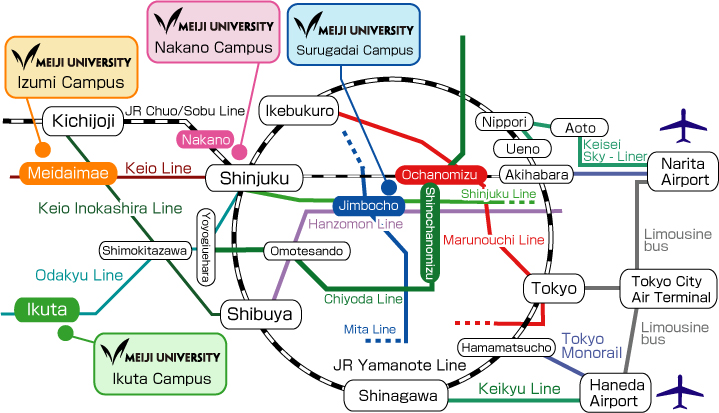

Organizers
General Chair:Yuriko Takeshima (Tokyo University of Technology)
Program Chair:
Takayuki Itoh (Ochanomizu University)
Hiroaki Natsukawa (Osaka Seikei University)
Local Coordinate Chair:
Jun Sakakibara (Meiji University)
Organizing Committee
Liang Li (Ritsumeikan University)
Hideo Miyachi (Tokyo City University)
Midori Yano (Sophia University)
International Program Committee:
Chongke Bi (Tianjin University, China)
Siming Chen (Fudan University, China)
Takanori Fujiwara (University of Arizona, USA)
Masahiko Itoh (Hokkaido Information University, Japan)
Michael Krone (Stuttgart Technical University of Applied Sciences, Germany)
Karsten Klein (University of Konstanz, Germany)
Guozheng Li (Beijing Institute of Technology, China)
Jie Li (Tianjin University, China)
Christy Jie Liang (University of Technology Sydney, Australia)
Quang Vinh Nguyen (Western Sydney University, Australia)
Jorji Nonaka (Riken, Japan)
Guide Reina (University of Stuttgart, Germany)
Ryosuke Saga (Osaka Metropolitan University, Japan)
Ken Wakita (Institute of Science Tokyo, Japan)
Lingyun Yu (Xi'an Jiaotong-Liverpool University, China)
Ying Zhao (Central South University, China)